Local SEO for Small Business: The Complete 2026 Guide
Digital Marketing · 6 min read · · Updated
By Heath Daniel, Founder & AI Platform Architect, HD Connex · Published:
Direct answer: Local SEO for a small business is decided by three signals: proximity to the searcher, how clearly your site says what you do and where, and outside evidence that you are credible. Proximity is fixed. Work the rest in order — Google Business Profile first, then service pages and consistent details, then reviews and local links.
The order is what most owners get wrong. They buy a citation package or argue about keywords while the Google Business Profile — the one asset that costs nothing and moves fastest — sits half-finished. Local search rewards a particular sequence, and working it out of order is how months of effort produce nothing you can point at.
Three things decide whether local SEO for small business works at all:
- Proximity: how close your business is to the person searching. This is the one you cannot change.
- Clarity: how plainly your site states what you do, and which towns you do it in.
- Credibility: how much evidence exists outside your own website that you are real and worth calling.
Proximity is fixed, so the rest of this guide is about the other two — in the order that moves them fastest.
What a local search actually returns
One search returns two different result sets, and they are won differently.
The map pack is the short block of businesses shown with a map, usually three. It is driven mostly by your Google Business Profile — your categories, your review activity, your details, and how far you are from the searcher. Your website influences it, but the profile does the heavy lifting.
The organic results below it are ordinary web rankings. Those are won by pages on your own site: the service page, the city page, the guide that answers the question someone typed.
A small business needs both, because the same buyer usually checks both. Treating local SEO as one job is why so much effort produces nothing — the work that wins the map pack is not the work that wins the blue links.
Step one: finish the Google Business Profile before anything else
This is the highest-leverage asset you own and the one most often left half-done. It costs nothing, it updates in days rather than months, and in a lot of local categories it decides whether you appear at all.
Work through it in this order:
- Primary category: pick the one category that matches what you actually sell, not the broadest one on the list. Add secondary categories after, and only where they are genuinely accurate.
- Services and products: list them individually with plain descriptions. Each entry is a phrase a buyer might search.
- Service area: set the towns you really serve. Claiming an entire state dilutes the signal rather than widening it.
- Hours, holiday hours included: wrong hours create bad experiences, and bad experiences create bad reviews.
- Photos: real ones, added regularly — your premises, your crew, finished work. Stock photography does nothing here.
- Questions and answers: seed the questions you field on the phone every week, and answer them properly.
None of that needs an agency. It typically needs an afternoon, and then a few minutes a month — and the upkeep is the part that usually lapses.
Step two: make the website answerable on its own
Google has to be able to work out from your site alone what you do and where you do it. Three things carry most of that weight.
Dedicated pages. One page per service, and where it genuinely applies, one page per town you serve. A single page trying to rank for six services across four towns ranks for none of them. The test for whether a city page deserves to exist is simple: can you write something specific and true about working in that town? If not, skip it. A thin city page is worse than no city page.
Consistent name, address and phone. The same business name, the same address format, the same number everywhere it appears — site footer, profile, directory listings. Variations are not fatal, but they make Google guess, and guessing costs you.
Local business structured data. Schema markup states your name, address, phone, hours and service area in a form a machine reads without having to interpret your layout. It does not rank you by itself. It removes ambiguity, and ambiguity is most of what you are fighting.
Step three: reviews as a process, not a push
Reviews feed the map pack, and they are the first thing a buyer actually reads. Most small businesses treat them as an occasional campaign — a batch of requests when things go quiet — which produces a spike and then silence.
A steady trickle beats a burst. Build the ask into the job itself:
- Ask at the moment the customer is happiest, which is usually as the work is signed off, not days later by email.
- Make it one tap. A link someone has to hunt for does not get used.
- Reply to every review, the good ones included, in your own words.
- Answer negative reviews briefly and factually, then take the argument off the platform. A calm, specific reply reads better to the next buyer than silence or a defensive one.
Reviews that mention the service and the town are the most useful, because they put your buyers' own language on the page. You cannot script that, but asking what you did for someone, rather than asking for a review, tends to produce it.
Step four: citations and local links, in that order of effort
Citations are listings of your business on other sites — directories, chambers, trade bodies. They work as corroboration: several independent sources agreeing on your details. The useful version of this task is getting the major ones right and consistent, and it finishes. There is no prize for appearing in hundreds of low-quality directories, and there is real cost in the duplicate listings and stale phone numbers they leave behind.
Local links are harder and worth more. They come from being a real participant in a real place — the chamber, a sponsored team, a supplier who lists their installers, local coverage of something you actually did. One link from a genuinely local, genuinely read site does more than a long row of directory entries.
Where AI answers change the picture
A growing share of local questions now get answered before anyone clicks: an AI Overview, or an assistant asked who the good roofer nearby is. Those systems fetch pages much the way a crawler does, and they quote what is unambiguous.
In practice that pushes in the same direction as everything above, with two additions. Answer the question directly on the page, in a sentence that stands on its own, instead of burying the answer in a paragraph of setup. And make sure the answer is in the HTML — a page that assembles its content in the browser can be invisible to the systems doing the quoting while looking perfectly fine to you.
A realistic order of operations
Starting from nothing, this sequence front-loads what moves fastest:
- Complete the Google Business Profile properly, services, service area and photos included.
- Build or fix the one service page that matches your most profitable job.
- Put consistent name, address and phone across the site and the profile, and add local business schema.
- Make the review ask part of the job, and reply to everything.
- Correct the handful of major citations that are wrong.
- Add city pages only where you can say something specific about that town.
- Earn local links through things you were going to do anyway.
How to tell whether it is working
Rankings are a poor first signal, because what someone sees depends on where they are standing. Watch these instead, over months rather than weeks:
- Calls and direction requests from your profile, which Google reports back to you.
- Which search terms are showing your pages, and whether they are terms a buyer would really use.
- Whether your service pages are gaining impressions even before they gain clicks — the earliest sign a page is being taken seriously.
- Inquiries and calls you can trace back to search.
Local SEO is slow and then it is durable. Profile work shows up in weeks. Page and link work takes months, and then keeps paying.
Where this usually goes wrong
- Building city pages for towns you have never worked in.
- Stuffing keywords into the registered business name.
- Buying bulk directory submissions.
- Rewriting the home page every quarter instead of building out service pages.
- Treating the Google Business Profile as a one-time setup.
Want a second opinion on yours?
HD Connex builds websites, lead generation systems and local SEO for small and mid-size businesses in Daytona Beach and Volusia County, across Florida, and for remote clients nationwide. If you are comparing Daytona Beach SEO services specifically, that page sets out what the work covers, what it costs, and what we do not sell. If you want to know which of the steps above is actually your bottleneck, book a free consult — you get a straight answer and a fixed quote before any work starts.
Sources and further reading
See it live: A2Z Outdoor Services
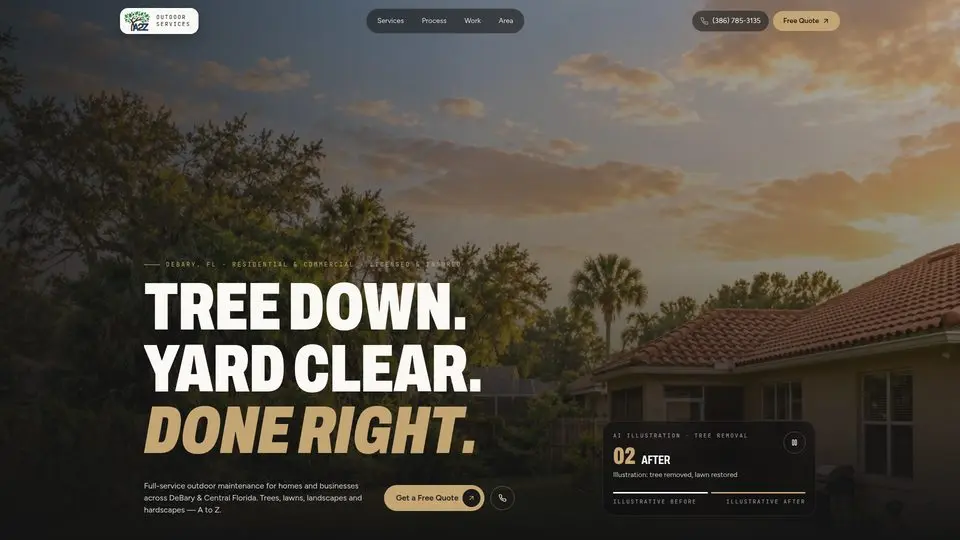
Central Florida tree service.
Frequently Asked Questions
How long does local SEO take for a small business?
Google Business Profile changes often show up within a few weeks. Page and link work is slower — typically a few months before rankings and impressions move, and longer in competitive categories. Anything promising top rankings by a fixed date is guessing.
What matters most in local SEO for a small business?
A complete, accurate Google Business Profile, because it drives the map pack and updates fastest. After that: one strong page per service, consistent name, address and phone everywhere, and a steady flow of reviews.
Do I need a city page for every town I serve?
No. Build a city page only where you can write something specific and true about working in that town. Thin pages spun from a template for places you have never worked tend to hurt more than they help.
Topics: Local SEO, Google Business Profile, Small Business, GEO, Florida
Written by Heath Daniel
Founder & AI Platform Architect, HD Connex. Heath builds the websites, AI agents and lead systems HD Connex ships for Daytona Beach and Volusia County businesses, and writes up what works from real client builds. About Heath
Keep reading
- Can an AI Agent Answer My Business Phone? What It Can and Can't Do on a Call (AI & Automation)
- Do I Need a New Website Before I Can Add an AI Agent? (AI & Automation)
- The Hidden Cost of Slow Websites (Performance)
Related: Volusia County AI Visibility Study (2026) · Daytona Beach SEO Company · Lead Generation Daytona Beach · Volusia County Web Design Company Guide · Contact Us · Industry solutions (Daytona Beach) · Website design packages