Inventory Ace: How We Built Bar Inventory Software That Scans, Forecasts and Keeps Every Bar's Data Its Own
Web Development · 5 min read ·
By Heath Daniel, Founder & AI Platform Architect, HD Connex · Published:
Direct answer: Inventory Ace is bar inventory software for multi-bar operators: barcode scanning, stock transfers, cycle counts, event staffing and an analytics engine that forecasts demand from transaction history. HD Connex built it as a FastAPI and SQLite backend with a React 19 offline PWA front end, deployed with Docker on Railway, in 191 commits between February 22 and July 19, 2026.
Inventory Ace is bar inventory software for multi-bar operators: barcode scanning, stock transfers, cycle counts, event staffing and an analytics engine that forecasts demand from transaction history. HD Connex built it as a FastAPI and SQLite backend with a React 19 offline PWA front end, deployed with Docker on Railway, in 191 commits between February 22 and July 19, 2026.
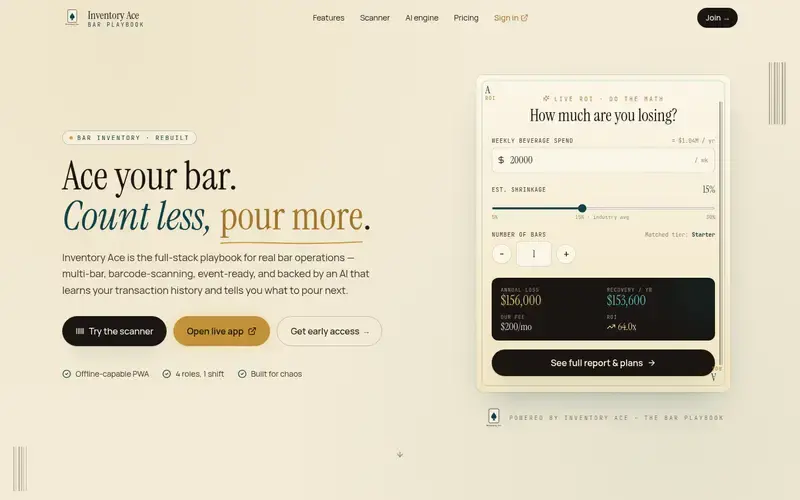
What Inventory Ace does
The site at inventoryace.shop puts it in one line: Ace your bar. Count less, pour more. It tracks liquor, beer and wine from supplier delivery to the moment a drink is poured, sold or spilled, across storage and per-bar locations. Staff scan barcodes with a phone camera or key them in; the catalog carries wholesale cost and sell price; par levels drive low-stock alerts. Transfers run as request, ship and receive, with stock deducted at ship and added at receive. Cycle counts reconcile the shelf against the system and log variance. Events carry staff, guest count and budget, with transactions linked for per-event reporting. Four roles (admin, bar manager, barback and event staff) decide who can do what.
Where it started: one bar's network, one PC, phones that could not scan
The first commits on February 22, 2026 are a project called BarTrack Pro, and the design notes from that day say what it was for: Bike Week bar operations. The React front end kept everything in the browser's local storage, so each device had its own inventory. The plan approved that day wired the front end to the FastAPI backend and put one shared inventory on the host PC, with phones scanning and a tablet as the dashboard. The catch was the camera: mobile browsers refuse camera access over plain HTTP on anything but localhost, so we generated locally trusted certificates with mkcert, served the app over HTTPS on the bar's own network, and had FastAPI serve the root certificate so staff could install it on their phones. The next day an iOS-only camera failure turned out to be a render-timing race that desktop browsers had masked, and on February 25 the scanner was rewritten on the ZXing browser library.
The one hard problem: every visitor saw the same bar
By March 2 the backend had been rewritten from JSON files onto SQLite in write-ahead-log mode, with bearer tokens, login lockouts, a setup wizard, a Docker image and a standard-library analytics engine. It was deployed to Render on March 4 and rebranded Inventory Ace on March 5. Our own multi-tenant note records what happened next: the first visitor ran setup and created a company, and every visitor after that saw the same company and the same data, because one database held one company and the API never filtered by tenant. The fix landed on March 23 as row-level isolation. Every tenant-scoped table got a company id, the same id rides in the user's token, and every list endpoint filters by it, so a user only ever sees their own company. An April 17 decision record explains the follow-up: SQLite cannot add foreign-key constraints to existing columns, so a one-time migration rebuilt all 31 tables with cascading deletes, backing the database up first, so deleting a company really removes its data. A July QA pass found the login screen's profile picker depended on a user-list endpoint that did not exist, and because a public user list would leak tenant usernames, it became a plain username and PIN form.
What we built, and what it runs on
The backend is Python 3.12 and FastAPI over SQLite in WAL mode, so reads proceed while a write is in progress. The front end is React 19 with Vite and TypeScript, Tailwind and shadcn/ui, with TanStack Query for data, a hash router and a lazily loaded chunk per route. It is an offline-capable PWA whose service worker caches assets cache-first and API responses network-first with a stale fallback. The analytics engine computes sales velocity, week-over-week momentum, a seven-by-twenty-four busy-hour heatmap, location rankings and an exponentially weighted demand forecast with reorder alerts; July added variance and shrinkage, pour cost, dead stock and supplier-grouped purchase-order suggestions behind subscription tiers, plus Ask Ace, a chat endpoint grounded in the analytics snapshot. Billing is Stripe; an April 17 decision record covers the webhook_events table that ensures a webhook delivered twice is processed once. The app ships as a two-stage Docker image, Node building the Vite bundle and Python running uvicorn, deployed to Railway with the database on a persistent volume; the marketing site is a separate Create React App on Vercel, split from the app on May 28. Capacitor iOS and Android projects exist in the repository, but the product is delivered as an installable PWA, and the store checklist in the README still has open items. The backend has 125-plus integration tests, each test file run against a throwaway SQLite database.
What shipped, and when
191 commits between February 22 and July 19, 2026:
- February 22 to 26: BarTrack Pro source, local-network HTTPS, ZXing scanner, PWA install prompt.
- March 2: SQLite rewrite, security hardening, analytics engine, Docker.
- March 4 to 5: first cloud deploy, event P&L, rebrand to Inventory Ace.
- March 23: multi-tenant isolation and billing scoped to company.
- April 14 to 17: testing framework, four decision records, move from Render to Railway.
- April 19 to 29: per-bar pricing, lead capture, the marketing site.
- May 2 to 5: hardening for 42 priority findings from a security scan, atomic inventory updates.
- May 26 to 28: the inventoryace.shop domain, marketing site split from the app.
- June 18: fifteen-issue audit.
- July 19: tiered analytics, bulk import, design system, command palette, Ask Ace, QA fixes.
What we would do differently
- Filter by tenant from the first hosted deploy. The note documenting the leak describes two browsers seeing one company's data, the wrong way to find it.
- Write the foreign-key constraints into the first schema; rebuilding 31 tables in a live database is a migration nobody wants.
- Keep the marketing site and the app separate from day one; sharing one domain meant a run of routing fixes in late April and early May.
- Test on a phone first: the first camera bug only showed on iOS Safari, and two more iOS fixes followed within a week.
Building operations software in Florida?
HD Connex builds custom software, web apps and AI agents from Daytona Beach for businesses across Volusia County and Florida. Every engagement starts with a free consult and a fixed quote before any build.
Sources and further reading
See it live: Inventory Ace
Bar inventory tracking, now adding food.
Frequently Asked Questions
What is Inventory Ace and who is it for?
Inventory Ace is bar inventory software for bar and nightlife operators, multi-location groups and event operators. It tracks liquor, beer and wine from delivery to pour with barcode scanning, stock transfers, cycle counts, event staffing, shifts, purchase orders and an analytics engine that forecasts demand from transaction history.
What does Inventory Ace run on?
A Python 3.12 FastAPI backend over SQLite in WAL mode, a React 19, Vite and TypeScript front end with Tailwind and shadcn/ui, Stripe for billing, and a two-stage Docker image deployed to Railway with the database on a persistent volume. The separate marketing site is a Create React App deployed to Vercel.
Is Inventory Ace a native mobile app?
No. It is an offline-capable progressive web app that installs to the home screen on iOS and Android, with a camera barcode scanner. Capacitor iOS and Android projects exist in the repository, but the README's store checklist still has open items, so there is no App Store or Google Play release.
How does Inventory Ace keep one bar's data separate from another's?
Through row-level isolation in a shared database. Every tenant-scoped table carries a company id, the signed-in user's token carries the same id, and every list endpoint filters by it. Foreign-key constraints with cascading deletes mean that deleting a company removes all of its data.
Topics: Project Story, Bar Inventory Software, FastAPI, React, SQLite, Railway
Written by Heath Daniel
Founder & AI Platform Architect, HD Connex. Heath builds the websites, AI agents and lead systems HD Connex ships for Daytona Beach and Volusia County businesses, and writes up what works from real client builds. About Heath
Keep reading
- Culver Realty Group: How We Rebuilt an Ormond Beach Brokerage Site With a Daily Listing Sync (Web Development)
- FloGuard: How We Built a Port Orange Drainage Contractor's Site, Then Made Every Page Readable to Crawlers (Web Development)
- What 63 Daytona-Area Business Websites Offer a Visitor After Hours (2026 Study) (Web Development)
Related: Custom software and web apps · Custom AI agents for Florida businesses · Web design and development in Daytona Beach · Book a free consult · Industry solutions (Daytona Beach) · Website design packages